Black Mental Health Week: Our Healing Is a Community Project, Not a Solo Journey
At Black Creek Youth Initiative (BCYI), we talk a lot about “safe space.” But what we really mean is this: space where you can bring your whole self – your jokes, your grief, your anger, your cultural pride, your trauma – and know you won’t be dismissed or punished for it.
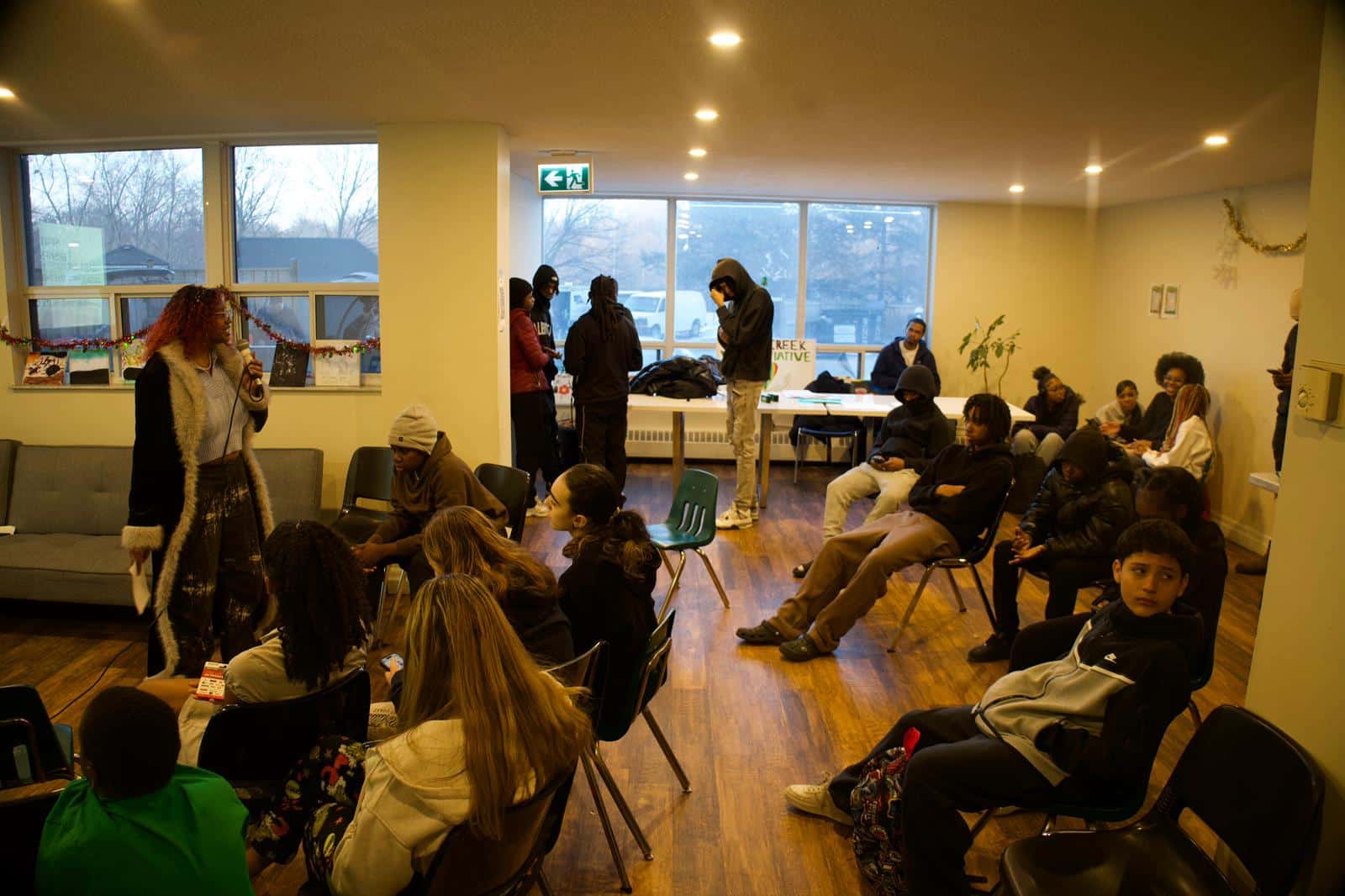
On any given Thursday evening, our room at Martha Eaton Way is full of life. Young people are playing games, debating music, telling stories, sharing food. From the outside, it might just look like another youth program.
But under the laughter, I often feel something heavier in the room: the weight Black youth are carrying in their minds and bodies.
That’s why Black Mental Health Week matters to us.
What Black mental health really looks like in our community
When we hear “mental health,” many people picture someone lying on a couch talking to a therapist. For a lot of Black youth and families, that’s not the starting point.
Mental health looks like:
– A young person who can’t sleep because they’ve lost friends or family to gun violence. – A youth who is scared to take the bus at night, but doesn’t want to “look soft.” – A newcomer teen trying to translate school emails, immigration letters, and bills for their parents, while juggling their own stress. – A young person being streamed out of academic pathways at school and starting to believe they are “not smart enough.” – A Black youth who is always “the strong one” for everyone else, but has nowhere to put their own feelings.
If you see yourself or someone you love in any of these examples, I want you to hear this clearly: you are not broken. You are responding to real conditions – racism, poverty, grief, immigration stress, school streaming, policing, and everyday disrespect that tells you your life is worth less.
Mental health is not just about what’s happening “inside” of us. It’s also about what’s happening around us.
As a social worker and Executive Director, I see both sides
I’m a Registered Social Worker and the Executive Director at BCYI. I’ve sat in therapy rooms. I’ve also sat in community rooms where youth are processing things that would break many adults.
I know what it’s like to navigate this city as a Black immigrant, to face systems that are not designed with us in mind, and to carry stress quietly because you feel you don’t have time to fall apart.
From where I stand now, between formal systems and community spaces, I’m learning a few things:
– We can’t talk about Black mental health without talking about racism and systemic violence. – We can’t keep telling people to “be resilient” while refusing to change the conditions harming them. – Healing has to be bigger than a workshop, a hashtag, or a single counselling session.
Black Mental Health Week gives us language and visibility. But for us at BCYI, this work is year-round.
Community as medicine
For many of our young people, the first step in healing is not calling a hotline or waiting on a long counselling list. The first step is not being alone.
It’s walking into a room where someone actually knows your name, remembers your story, and notices when you’re “off.”
It’s being able to say, “I’m not okay,” and hearing, “You’re not a burden. Let’s figure this out together.”
That’s why I often say: connection is medicine.
At BCYI, mental health support looks like:
– Consistent weekly spaces where youth know we will be there. – Staff and volunteers who share lived experience with the community. – Circle discussions where youth talk honestly about grief, anxiety, racism, school, and family without feeling judged. – Food on the table, because it’s hard to talk about healing when you are hungry. – Laughter, music, art, and games – because joy is not a distraction from the work, it is part of the work.
We are not a clinic. We are a community. But the impact on mental health is real.
What we’re committing to this Black Mental Health Week
This week, as conversations about Black mental health are happening across the city, here is what we are recommitting to at BCYI:
– Listening deeply to young people, not just asking them to “be strong.” – Naming racism and systemic barriers as part of the mental health story, not as a side note. – Creating more spaces for youth to process grief and loss together, including the losses that are often hidden or minimized. – Building stronger pathways to Black and culturally responsive therapists and mental health supports, and making those referrals feel safe – not like a punishment. – Making room for joy, creativity, rest, and play, even when things are heavy. – Advocating with partners and institutions so that systems shift, not just individuals.
For us, mental health is not a separate “topic” we pull out once a year. It is built into how we design programs, how we talk to each other, and how we show up for young people.
A message to Black youth
If you are a Black young person reading this, whether you come to BCYI or not, this part is for you.
You are not “too emotional.” You are not “dramatic.” You are not “cold.” You are a human being reacting to real things that have happened to you and around you.
It is okay if some days you feel tired, numb, angry, or sad for reasons you can’t even name. It is okay if you’re the one everyone leans on, and you’re starting to feel like you have nothing left to give.
You deserve spaces where you don’t have to perform strength to be respected.
You deserve adults who believe you the first time you tell them something is wrong.
You deserve a soft life, not just a strong life.
If you’re struggling, talk to someone you trust – a friend, a mentor, a family member, a youth worker, a teacher who “gets it.” If you’re part of BCYI, talk to one of us. We would rather have a hard conversation now than wish we’d checked in later.
And if you are ever in immediate crisis, please reach out to professional supports in your area. In Canada, you can call or text 9-8-8 for mental health crisis support, 24/7. You are not alone.
A message to adults, allies, and service providers
If you work with Black youth – as a teacher, social worker, parent, neighbour, or community partner – Black Mental Health Week is an invitation to do more than post a quote.
It is an invitation to:
– Believe Black youth when they tell you they are not okay. – Examine the ways your systems (schools, agencies, workplaces) may be adding to their stress. – Make referrals to mental health supports early and without shame, and be willing to walk alongside youth as they navigate those systems. – Invest in Black-led, community-based organizations that have trust and relationships on the ground. – Ask youth what they need, rather than assuming you already know.
Sometimes, the most powerful thing you can say is, “I don’t have all the answers, but I am here with you in this.”
Our healing is collective
Black Mental Health Week is one week on the calendar. For our community, the experiences that make it necessary are present all year.
At BCYI, we are committed to walking with youth through both the heavy and the hopeful. We have seen again and again that when young people are heard, believed, and supported in community, they don’t just survive – they lead, create, and transform the spaces around them.
Our healing is a community project, not a solo journey.
If you’re reading this and you’re part of the Black Creek community, consider this an open invitation: to show up, to check in on a young person, to ask for help when you need it, and to remember that you don’t have to carry everything alone.
From all of us at BCYI, we see you. We’re in this with you.
— Destin Bujang Executive Director, Black Creek Youth Initiative, Registered Social Worker